How Understanding Greatness works
"Instead of making history, we are made by history." Martin Luther King Jr.
"History is a set of lies agreed upon." Napoleon Bonaparte
Analytical, not academic
Understanding Greatness is not an academic exercise. It does not claim to possess definitive answers, nor does it exhaustively cross-reference every leader, event, or source to establish a perfectly objective account of what happened. It draws on biographical sources and applies analytical deduction to extract lessons from pivotal moments.
Subjective by nature, structured by design
We freely admit that the lessons here can be disputed, incomplete, or subjective. After all, what objective lessons could one draw from figures such as Napoleon Bonaparte, Otto von Bismarck, Catherine the Great, or Steve Jobs? Different people will inevitably arrive at different conclusions. What UG offers is a standardised framework that makes it possible to deduce those lessons consistently and comparably across cases.
We analyse situations, not leaders
Understanding Greatness does not treat leaders as the primary unit of analysis. It focuses on situations. Leaders are nearly impossible to categorise across their full lifespans, and the circumstances they faced changed constantly. UG examines three dimensions per case study:
1) the leader's actual power and authority at the moment under review,
2) the core challenge they were facing and
3) the strategy they used to navigate their circumstances.
This is what allows us to contextualise their decisions and draw lessons from them. These three dimensions structure every case in the library.
Execution: from leadership theory to actual behavior
Strategy without execution is just an intention. What makes leadership decisions instructive is not what leaders planned but what they actually did: how they translated strategy into action, how they managed the people around them, and how they held their course or changed it under pressure. This is where the most transferable lessons live, and it is where UG places its analytical focus.
The Understanding Greatness Framework
Great leadership is defined by the fit between the challenge a leader faces, the position they hold, and the strategy they choose in response.
Power Position

How strong was the position and perceived authority of the leader at that particular moment?
Power is more than a title. It is the combination of authority, legitimacy, coalition strength, and room to maneuver at a specific moment.
UG classifies the power position in every case as one of these:
1) Unchallenged
The leader has more power than any realistic opposition. The real challenge is knowing how much of it to use.
2) Conditional
Real and strong authority, but dependent on the continued cooperation of people who granted it and could withdraw it. Every significant move carries the risk of fracturing that support.
3) Constrained
Authority is secure and legitimate, but something resists what the leader needs to do with it. The mandate exists. The room does not.
4) Fragile
The foundations of the position could give way. One lost ally, one bad decision, one decisive defeat changes everything. Survival is the precondition for everything else.
Core challenge

What was the situation demanding of the leader at that particular moment?
What a situation demands depends entirely on the moment under review. UG looks at each specific moment and asks: what was this situation fundamentally requiring of the leader?
The answer falls into one of four categories:
1) Survival
The essential thing is at risk. The immediate priority is keeping it intact. Everything else is secondary.
2) Consolidation
The immediate crisis has passed but the foundations are not yet solid. The priority is stabilising and securing what exists.
3) Expansion
The position is stable. The objective is to extend its reach, influence, or impact beyond the current limits.
4) Transformation
The situation likely requires changing the fundamental terms, not winning within them.
Incremental improvement or stabilisation is insufficient. The moment demands something structurally new.
Strategy
.jpg)
What did the leader actually choose to do in response to their position and challenge?
The strategic approach describes the leader's actual response in our case studies.
UG identifies five strategic approaches.
1) Restraint
Deliberately not using available power or not taking available action. The strategic logic is conservation: do not spend what you cannot replace, do not give them the crisis they want, do not act until the conditions justify it. Restraint is an active choice, not passivity.
2) Adaptation
Change the approach, the definition of success, or the relationship to the constraint when the original path is no longer viable. Adaptation is not surrender. It is finding the viable position within an unworkable situation and governing from there.
3) Pressure
Apply sustained, calculated force that others cannot ignore and must respond to. Drive conditions rather than respond to them. Pressure requires precise timing, a window of opportunity, and the willingness to accept the costs of forcing an outcome.
4) Redefinition
Change what the conflict, the negotiation, or the situation is fundamentally about. Do not fight within the existing frame. Change the frame.
5) Innovation
The leader chooses to build something the existing framework has no category for. Where redefinition changes what the challenge is about, innovation abandons the fight altogether and builds on entirely new ground, whether politically, culturally or societally.
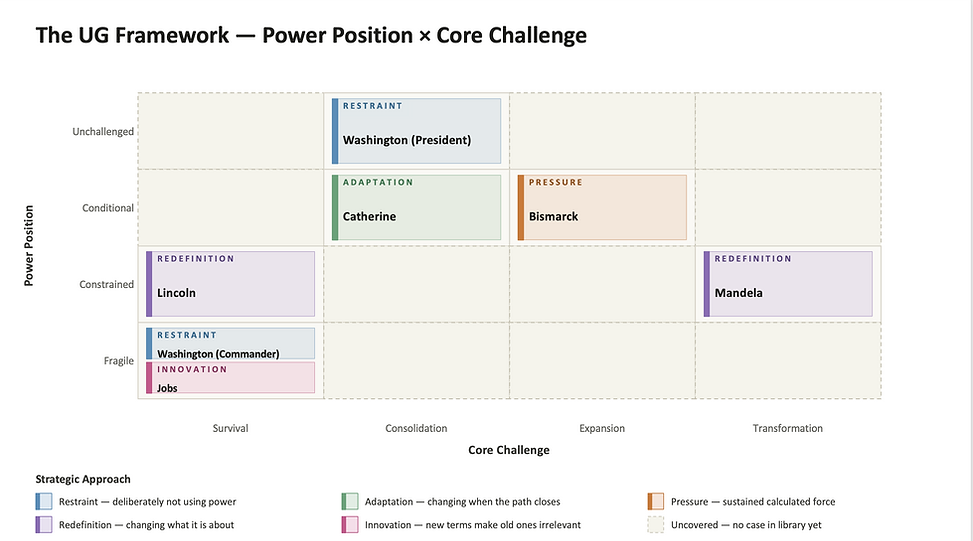
The matrix below plots every current case across all three axes simultaneously. Empty cells represent structural situations not yet covered by the library.